The U.S.-Japan Alliance
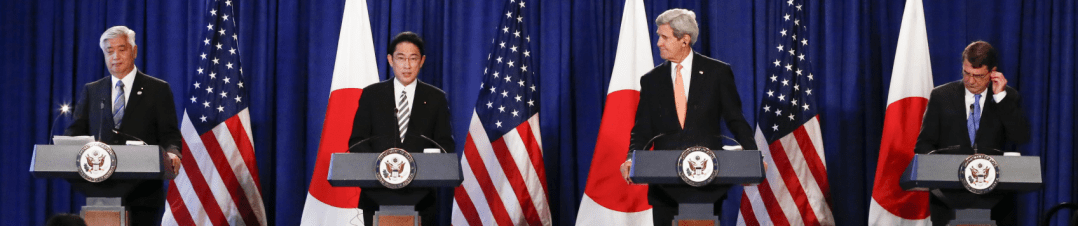
Following the collapse of the Cold War system, East Asia has been in a period of transition. Although various countries are contending to become the dominant Asian power, the U.S.-Japan alliance will continue to serve as the cornerstone of security in East Asia. The strength of the bilateral ties is based on the common interests and values of stability in the Asia Pacific region, advancing political and economic freedoms at a regional and international level, and advocating human rights and economic institutions. With their combined economic and technological influence, the U.S. and Japan are rooted in the shared interest of promoting global growth, open markets, and a vital world trading system. Both collaborate together on promoting multilateral economic ties through the WTO, IMF, and other international organizations. Coordination and regional influence of the two governments is exemplified through their hosting of the Asia-Pacific Economic Cooperation: Japan (2010) and the U.S. (2011). Through bilateral economic ties, both countries serve as a major market for the other. In 2009, U.S. imports from Japan reached $195.9 billion and U.S. exports to Japan totaled $51.2 billion (State Department).
The 1960 U.S.-Japan Security Treaty serves as another pillar in the relationship, especially in the fight against terrorism and the denuclearization of North Korea. Japan’s global security role in U.S.-led military operations in Iraq and Afghanistan has demonstrated that Japan can make contributions without violating Article 9 of the Constitution. Despite its withdrawal of troops from Iraq in December 2008, Japan’s role in Afghanistan (U.S. $5 billion in assistance) is only third to the U.S. and U.K. Lastly, although Pyongyang’s increasing aggressiveness amidst its leadership change poses a regional challenge, Japan will play an instrumental role – along with China and South Korea – in reaching out to new leaders in a post-Kim era. In the event of unification (but not likely soon) in the Korean peninsula, Japan is likely to play a vital role in its reconstruction.
Challenges to the U.S.-Japan relationship and the region are partly due to each state over-insuring against perceived risk of the other (Richard Samuels). Pyongang’s unpredictable behavior stems from its fear of survival in the world, in which the U.S. may reinstate the regime as a state sponsor of terrorism. South Korea is a geostrategic peninsula, as it always has been, into Asia. China, which borders more countries than any other, is aware of the U.S.-Japan alliance’s aims to contain its rise. Finally, Japan aims to maintain security through its alliance with the U.S. In turn, each country has developed missiles programs to increase its security, whilst making the others less secure. Despite tensions, however, the region is more stable under a U.S.-Japan (and U.S.-Korea) alliance than without it. Because of U.S.-Japan relations, Japan is East Asia’s source of stability and prosperity.
In conclusion, I believe the U.S. and Japan must continue to strengthen their military, political, and economic alliance to ensure regional stability and address challenges. However, bilateral talks are not enough. To diffuse rivalry and create transparency among the regional states, multilateral discussions are necessary. Spinning off the Six-Party Talks (excluding North Korea if necessary), discussions would need to address a post-Kim era, denuclearization of the Korean peninsula, Sino-Japanese military-to-military dialogue, free trade agreements, and contingencies planning for disaster-relief activities. Multilateral discussions would reduce concerns of nationalism on any of the states parts. Regardless, the U.S.-Japan relationship has grown since its inception in the Cold War. Regional and global in scope, both states must continue to reaffirm and bolster the other’s robust economy and geopolitical influence.

 Marshall J. Bennett